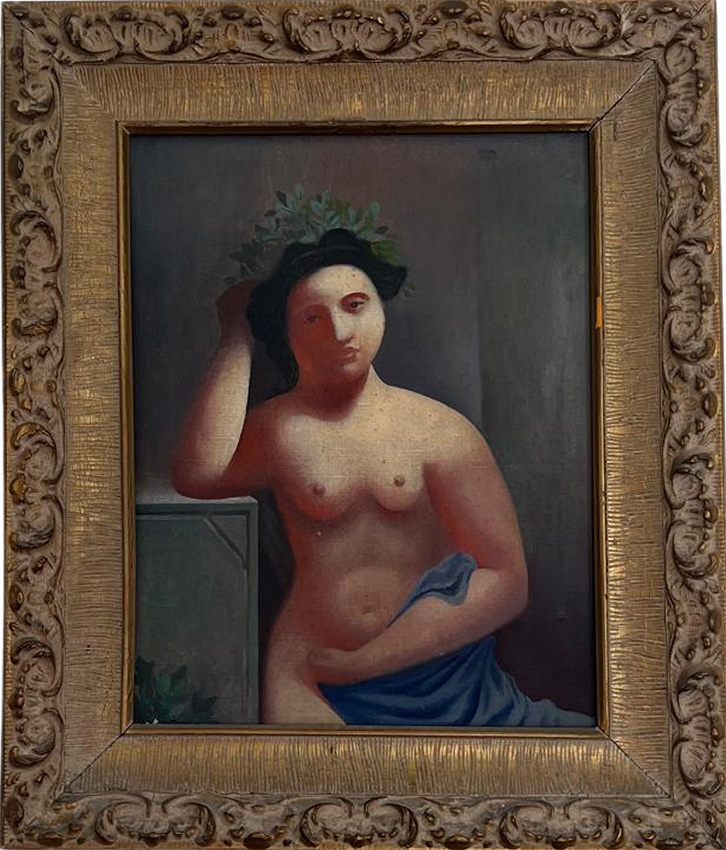
This piece, titled Bacchante, is by Byron Browne and dates to 1941, reflecting a Modern style. It is executed in Oil on canvas, showcasing the use of materials and technique. The dimensions and framing details are not specified, leaving its scale open to interpretation. The work is signed by the artist. Works in the modern tradition often emphasize technique and thematic expression, inviting viewers to engage with the subject and context. This summary is generated from catalog records and reviewed for accuracy in attribution, date, and materials. Its style and material qualities reflect the cultural context of the period, demonstrating craftsmanship and thematic depth.
"Byron Browne (1907 - 1961) also known as George Byron Browne, was born in Yonkers, New York. He was a modernist painter and one of the founders of American Abstract Artists, a New York City organization devoted to exhibiting abstract art.
Browne worked at a lumberyard to pay his tuition at the National Academy of Design, where he enrolled in 1925. He was inspired by European artists such as Pablo Picasso and Joan Miró and in 1930 burned several of his realistic works as a gesture against conventional painting.
He was a founder of the American Abstract Artists and in 1935 led a march protesting museums that did not collect modern work.
Browne specialized in still life in the style of Synthetic Cubism, influenced by his friends John Graham, Arshile Gorky, and Willem de Kooning.
After World War II, Browne exhibited frequently at the Kootz Gallery, which ardently supported avant-garde American artists. While abstract expressionism dominated New York’s art world, Browne’s paintings, which still showed recognizable figures and objects, failed to draw an audience. The gallery sold all of Browne’s work in a department store sale at “50% off,” dealing a heavy blow to the artist’s career. "

“To state upfront, I haven’t purchased anything from this shop so I don’t know how the prices compare. However, as a pedestrian always fascinated by this place, I enjoyed exploring two floors of antiques and art from around the world. The owner was kind enough to tell me the story behind a stained glass piece that belonged to George Washington’s family. It’s like getting up close to items in a museum!”
What a great find in Georgetown! Grace was an excellent tour guide and Peter is an absolute gem, will definitely be back! Highly recommend!
“L'Enfant Gallery is a haven of beauty and discovery! I often swing by just to walk around and bask in the incredible array of treasures!! I love the sheer variety and diversity it offers. I love hearing the stories behind each piece and embarking in an artistic time-travel of sorts! I love the staff, who are wonderful and so knowledgeable! And the events are great too! From fascinating lectures to more participatory proposals like a candle-lit yoga class! I always learn a lot and meet very interesting people! one of my top places in Georgetown and DC!!!”
“I have been a patron of L’Enfant Gallery since they hosted my wedding in 1985! As a resident of Georgetown for years, I have a long standing relationship with the gallery as a legacy Georgetown institution and Peter Colasante as an aficionado of all things art, neighbor and community pillar. In recent years L’Enfant Gallery has become more active in local events and is now an anchor in the Washington DC community arts festival (Art All Night). I have been fortunate to be able to attend some spectacular events at the gallery; a masquerade soirée, which was a sophisticated evening of intrigue where we chatted and sipped among the masters in disguise, slipping down the rabbit hole and dancing with DJs as the sky went from dark to light. A “dinner in the window”, hosted by L’Enfant Gallery showed them as a strong partner of Georgetown Mainstreet, supporting local restaurants in a one of a kind setting. Recently I attended a spelling-binding wedding celebration spanning the three floors of the gallery with cocktails, music and an interactive dance performance that led the way to the second floor which had been transformed into an intimate formal dining experience for over 50 people, prevailing F Scott’s panache for all the finer things… It is worth watching what is happening there when you are in town.”
“We found this spectacular gallery over 20 years ago and have acquired paintings, antique lights, furniture, and figurines from around the world there. The range and quality of the offerings on its several floors are stunning. Peter Colasante, the owner, has encyclopedic knowledge and is patient in explaining matters and answering your questions. It is the best gallery in D.C. Its reputation and longevity assure that you will find treasures and pieces not found elsewhere. We recently attended a gallery evening of music and song, with performances by singers, artists, and a magician.”
“I have gotten to know L’Enfant Gallery as an essential fixture in our Georgetown small business community. Peter, the owner, cares deeply about creating a safe and welcoming space, not only to shop for a diverse array of art and antiques, but also for artists to create within the gallery. I attended an incredible woman-led panel conversation “Art as Resistance” for the opening of their Wall of Women exhibition. I have also enjoyed how the gallery has used their storefront window as a living stage during Art All Night, Fall Market, and more- welcoming artists to create and perform. I had the pleasure of hosting a Dinner in the Window at the gallery to highlight our restaurant community in Georgetown. L’Enfant is a true partner for the arts and I would recommend engaging with them more, whether it is hosting an event, enjoying their diverse programming, or shopping their collection.”
"I've been shopping at L'Enfant Gallery since before opening my design firm in 1997. They occupy a rarefied space as purveyors of the finest antiques."

lorem ipsum lorem ipsum lorem ipsum lorem ipsum lorem ipsum lorem ipsum lorem ipsum lorem ipsum lorem ipsum lorem ipsum lorem ipsum lorem ipsum lorem ipsum lorem ipsum lorem ipsum lorem ipsum lorem ipsum lorem ipsum lorem ipsum lorem ipsum lorem ipsum lorem ipsum lorem ipsum lorem ipsum lorem ipsum lorem ipsum lorem ipsum lorem ipsum
Lorem ipsum dolor sit amet Lorem ipsum dolor sit amet Lorem ipsum dolor sit amet v Lorem ipsum dolor sit amet Lorem ipsum dolor sit amet Lorem ipsum dolor sit amet Lorem ipsum dolor sit amet
Lorem ipsum dolor sit amet Lorem ipsum dolor sit amet Lorem ipsum dolor sit amet Lorem ipsum dolor sit amet Lorem ipsum dolor sit amet Lorem ipsum dolor sit amet Lorem ipsum dolor sit amet
Lorem ipsum dolor sit amet Lorem ipsum dolor sit amet Lorem ipsum dolor sit amet Lorem ipsum dolor sit amet v Lorem ipsum dolor sit amet Lorem ipsum dolor sit amet
Lorem ipsum dolor sit amet, consectetur adipiscing elit. Aliquam est velit, feugiat feugiat risus eu, vestibulum sodales sapien. Etiam vel risus malesuada, viverra enim quis, faucibus leo. Nullam a accumsan mi, non ornare turpis. Vestibulum luctus tellus sed posuere maximus. Maecenas ut tortor eget metus vulputate tristique.