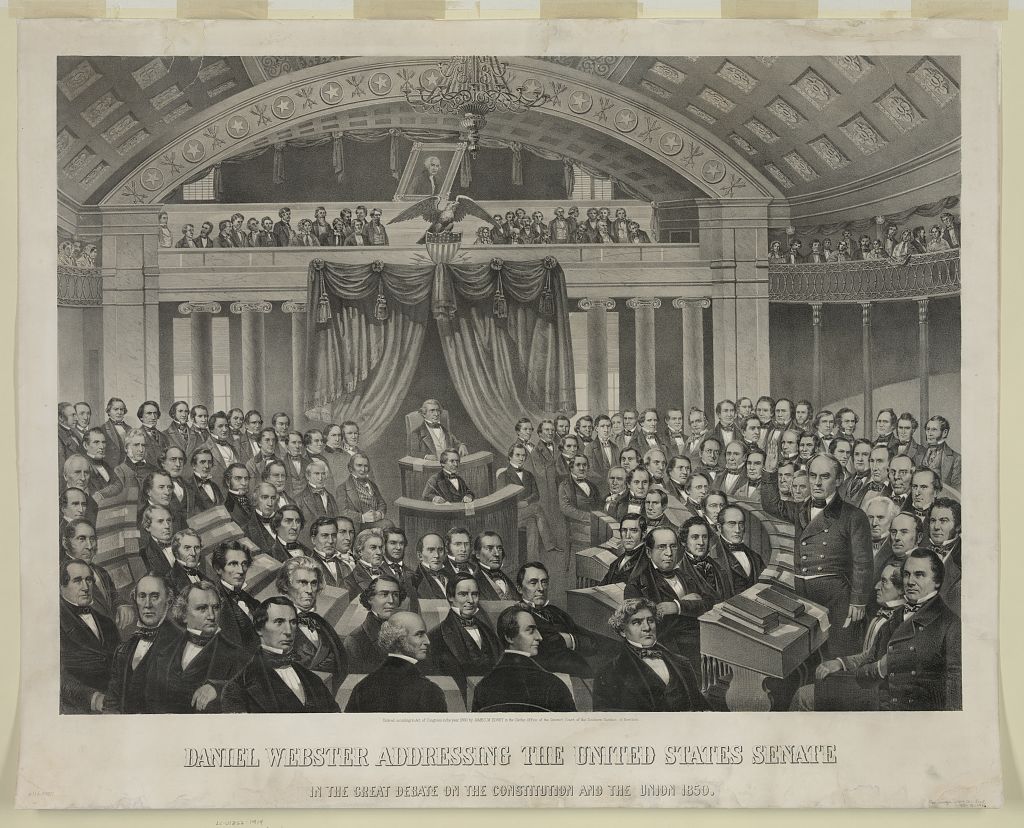
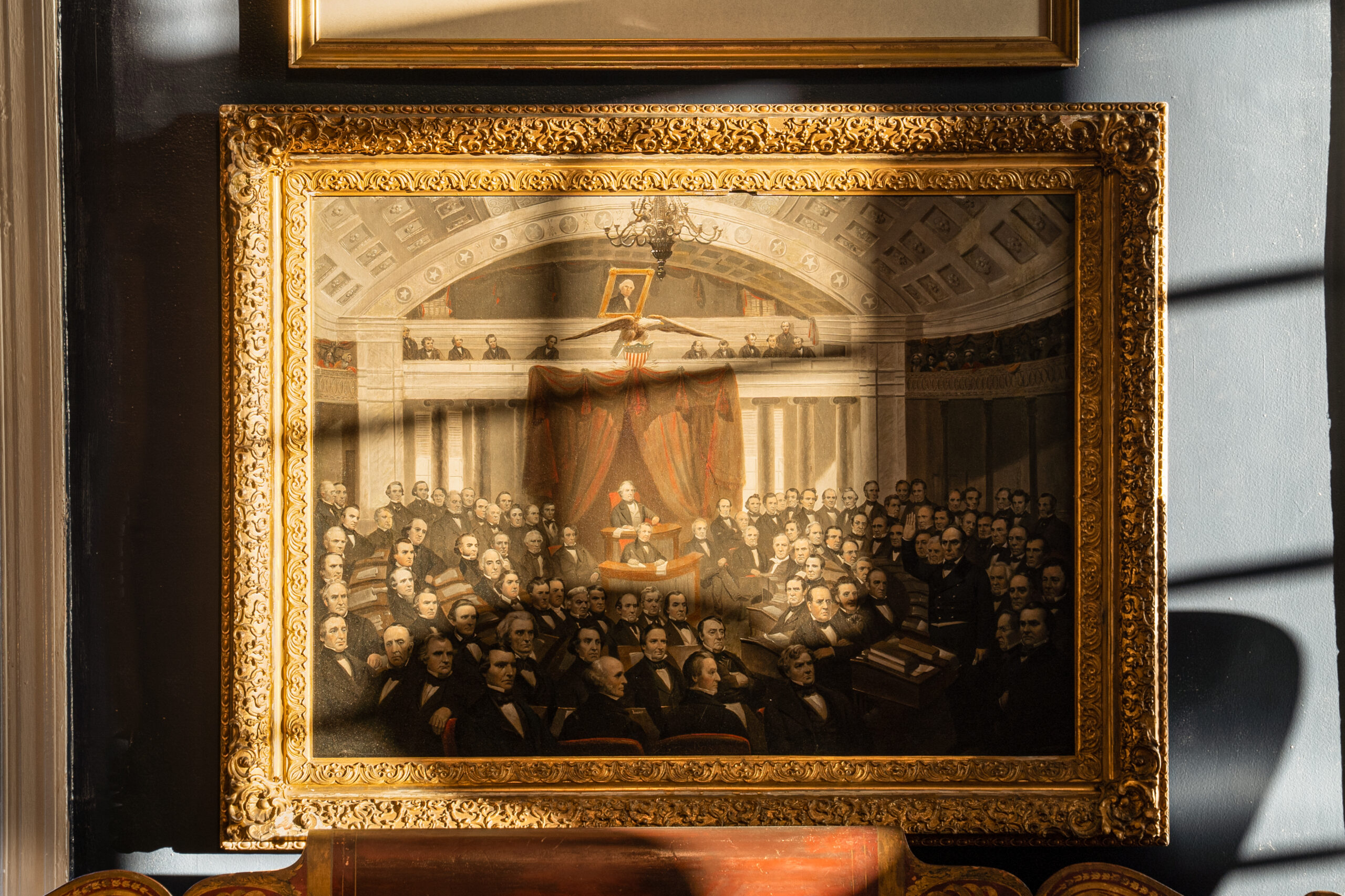
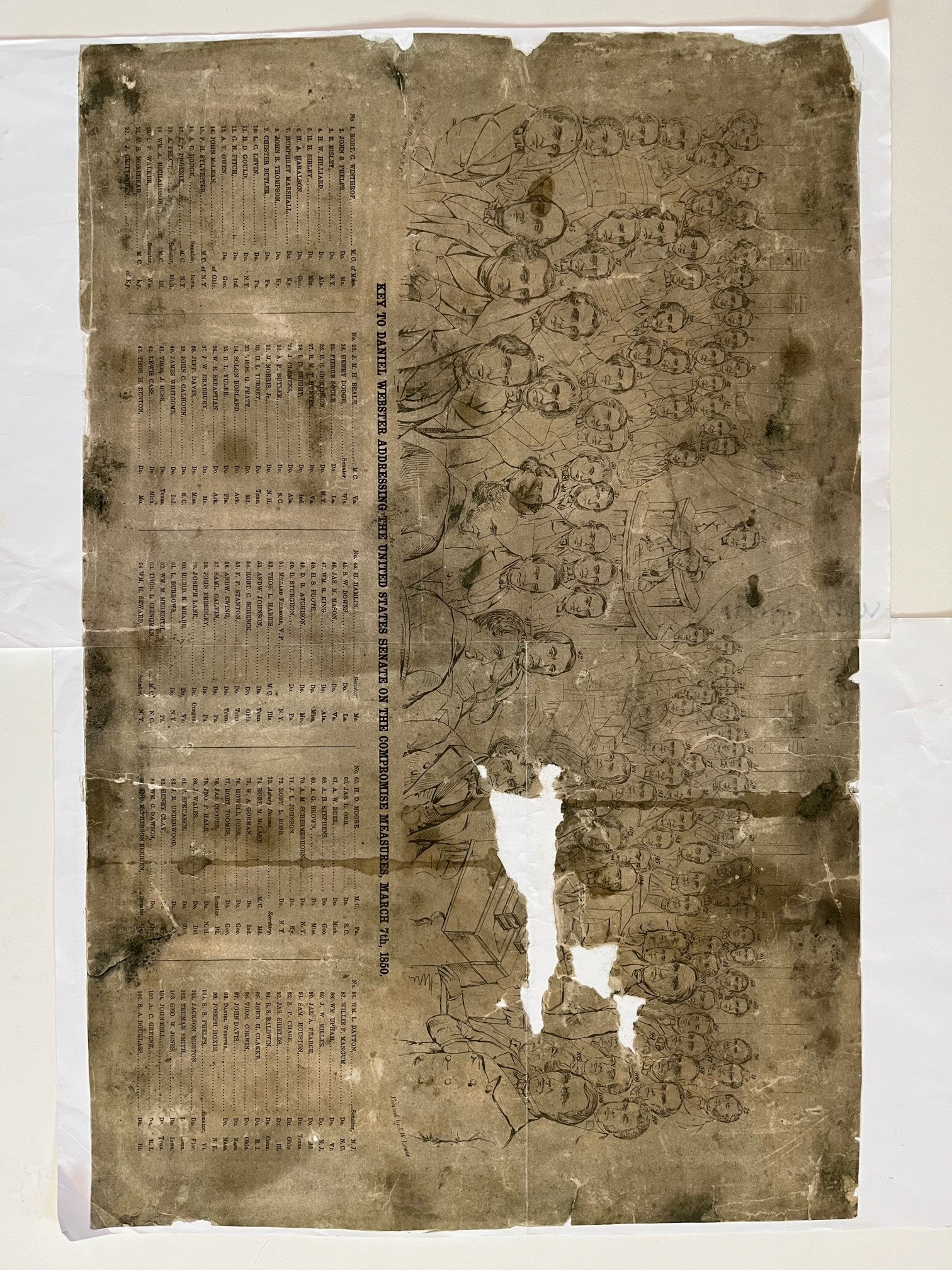
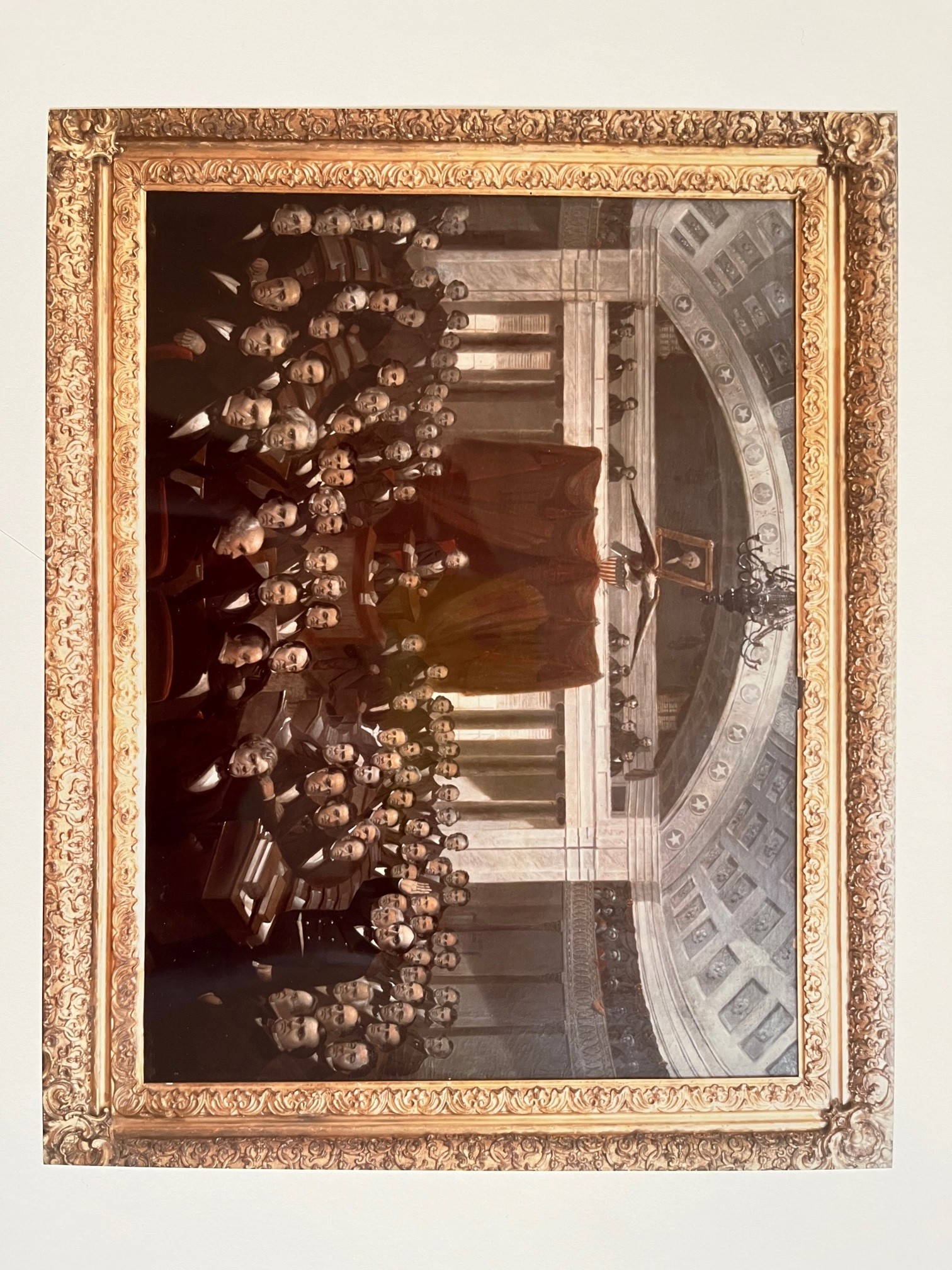
According to Barbara Wolanin, Curator Emerita, Architect of the Capitol, this representation of the Old Senate is the finest known, showing a full view of the Senate floor, the Gallery with a prominent eagle and shield carving, and a portrait of George Washington overhead.
This painting’s significance, however, transcends the nineteenth century. According to the late senator Ted Kennedy, it helped shape modern American history. Senator Kennedy was a client of Peter Colasante’s. One fall day in 1997, he encountered Daniel Webster Addressing the United States Senate on The Compromise of 1850 during a visit to L’Enfant Gallery. This proved to be an emotional experience for the senator. “He saw the picture in the back room and did not re-emerge,” Peter Colasante recalls. “After 15 minutes, I went to find him and he was crying. He told me this painting was the reason Jack became President.” According to Colasante, Senator Kennedy explained that
When JFK was elected to congress in 1946, there was a framed engraving outside the door of his first office; it was an engraving of this scene. When Ted used to visit his big brother in his office, JFK would point out the engraving to Ted and say, you see this picture; Webster was from Boston, we are from Boston, this is my idea, someday I want to have Webster’s seat in the Senate and be as important to this country as Webster was in his.” Jack would talk to Ted about Webster. The driving impetus that propelled JFK to the Presidency, according to Ted, was this vision he had in his head of the critically important role Webster played in his time.
Evidence of this enduring preoccupation can be found in Profiles in Courage, a book written by John F. Kennedy and published in 1956. In a chapter titled “Daniel Webster,” Kennedy praised Webster—described as “one of the most extraordinary figures in American political history”—for his unwavering tenacity, exemplified by his impassioned speech and the admirable sacrifice it entailed.
Eliphalet M. Brown Jr. (1816–1886) was a lithographer and a portrait, historical, and marine artist. He was born in Newburyport, Massachusetts, in 1816.
He worked and lived in New York City from 1839 until 1852, when he embarked on a two-year journey to Japan with Commodore Matthew Calbraith Perry, serving as a daguerreotypist and artist. His sketches of Japan were published on his return, and he remained connected to the United States Navy until 1875, when he retired upon his marriage. He died in New York City in 1886.
His work is represented by the United States Senate Collection, the National Portrait Gallery, and the Library of Congress, as well as the New York Public Library and the Museum of the City of New York. He exhibited at the National Academy in 1841. Much of his work is published: Perry, Expedition to Japan; Peters, Currier & Ives II, America on Stone, Clipper Ship Prints.
We believe that Brown produced an oil painting of Webster delivering his speech.
If you are interested in discussing the purchase of this item, please suggest your availability (EST) for a phone call with Peter Colasante via our contact page.